Showing posts with label loyal implementation. Show all posts

Wednesday, February 24, 2016

An honest question on responsible public service


by Kent Aitken RSS / cpsrenewalFacebook / cpsrenewalLinkedIn / Kent Aitkentwitter / kentdaitkengovloop / KentAitken


It seems as though Ottawa (and maybe only Ottawa) is abuzz with trying to interpret and incorporate the new government's direction into their advice, approaches, and presentations. Interpreting, even, how much influence a particular book and author will have on our organizations: the fact that a few core members of the Prime Minister's staff were all reading How to Run a Government so that Citizens Benefit and Taxpayers Don't Go Crazy was well-known and made the rounds. In our recent review of that book I wrote that one bureaucrat's environmental awareness could be another's reading tea leaves. I think this is worth unpacking and talking about.


Consider mandate letters. The government made Ministerial mandate letters - that is, direction from the Prime Minister to Ministers regarding their portfolios - public for the first time after last year's election.

Of course public servants should read these and be proactive about their role in turning these letters into reality.

But maybe, we should also be wary about mobilizing expensive public resources on the basis of bullet points for which we're not the intended audience. There are opportunity costs of other actions and tasks not done.


Of course public servants should be aware of the political environment, the agenda of the elected government, and how it's being communicated. And of course this should influence their work.

But maybe, it's overkill to have the full slate of public servants interpreting the political zeitgeist and changing their approach to public service and their advice to senior executives. I think it's equally reasonable to say that it's exactly the role of public service executives to contextualize direction - and insight into priorities - to guide work.


Of course public servants should be cultivating good working relationships with Ministers and Ministers' offices, indicating a willingness to work together and to dutifully implement the priorities of the government of the day.

But maybe, we still need to remember that "fearless advice" doesn't disappear during "loyal implementation," and that our best advice is still essential for our machinery of government. If we're implementing a decision that includes downsides, those downsides should be made clear so they can be minimized or mitigated. If the public service advice on an issue changed on October 19, one version simply wasn't the best advice possible. It's not our job to provide the "best advice desired" or "best advice approveable." It's "best advice."


I am emphatically not saying that the government shouldn't pivot when circumstances change, or that it should dig in its heels until hand-held towards action. But the actions and resources of government are not free, and we have to be responsible in their application. Nor am I saying that people are currently acting inappropriately - I'm just thinking about where we'd put the professional rumble strips in case we ever veer a little too far.

Mandate letters are new. Social media and the level of working-level access to Ministers, their staff, and their ideas is (relatively) new. We shouldn't pretend that 100% of the people receiving this deluge of potential insight about government direction will have the 100% correction interpretation and reaction, 100% of the time. 

There's an easy escape hatch to this dilemma and series of tradeoffs, but it has to happen throughout organizations:

Talk about things. Ask questions. Test assumptions.

So... can we talk about this?


"Of course... but maybe" is shamelessly robbed from Louis CK, and this isn't even the first time I've done it.


Friday, December 7, 2012

On risk, fearless advice, and loyal implementation

I've been thinking a lot lately about the issue of risk and how it relates to the idea of fearless advice and loyal implementation. Admittedly, these thoughts aren't entirely formed yet so bear with me.


When it comes to risk, we are our own worst enemy

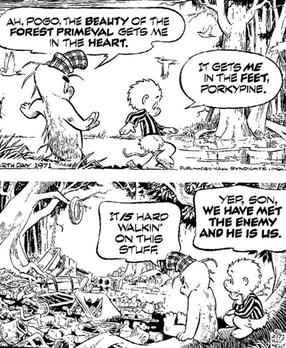
Generally speaking I feel as though civil servants over-inflate the risks of almost everything they (we) do. We often chalk it up to the culture, forgetting that if you stripped bureaucracy of the bureaucrats the risk averse culture would likely disappear. Sure the written rules will remain, but no where (to my knowledge, and in my experience) are the written rules actually as stringent as our interpretations thereof.  My thoughts on how we approach to risk are best summed up with the famous Walt Kelly line (pictured to the left): "We have met the enemy and he is us". We are responsible for the culture, to blame it, is to blame ourselves; on this, I doubt I can be convinced otherwise.


The relationship with fearless advice and loyal implementation

Before delving any deeper, I should probably hang this caveat out there. Recent discussions with a number of colleagues (at different stages in their career) have led me to the conclusion that I am likely an outlier in that I have a fundamentally different understanding of risk than is the norm. Yes - its surprising isn't it - I have a high tolerance for risk, but I also have a high tolerance for consequences arising from my actions; and in the real world risk and responsibility are inextricably linked.

However, inside the bureaucracy I'm of the view that they are artificially divided. By this I mean to say that even when someone is willing to take a risk and bear the responsibility for its consequences they can't actually do so.  Rather than being able to simply pull the trigger on something they are forced to crunch their willingness to move ahead into some sort of recommendation (often in a briefing note) that gets pushed upwards onto someone else.  Sometimes this can be a good thing, for example it protects junior employees from taking the heat if the shit hits the fan, but it can also be paralysing since it concentrates risk in certain areas which likely makes those areas more sensitive to risk than they would otherwise be.


That said, here's my (related) observations on fearless advice and loyal implementation

Giving fearless advice is a low risk activity; there are plenty of opportunities to do so all along the long tail, and most of them are behind closed doors.  Loyal implementation on the other hand is a high risk activity; execution is always a delicate matter, and always held to the highest degree of public scrutiny. I think that perhaps we (public servants) have been spending far too effort on loyal implementation and not enough on fearless advice. Our natural hypersensitivity to risks out there in the public realm have crept into our conciousness in here.

Here's my best effort and trying to boil that all down to a single image (click to enlarge):

Cheers


Originally published by Nick Charney at cpsrenewal.ca
subscribe/connect
RSS / cpsrenewalFacebook / cpsrenewalLinkedIn / Nick Charneytwitter / nickcharneygovloop / nickcharneyGoogle+ / nickcharney