Monday, May 7, 2012

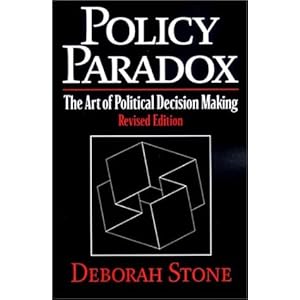
MBR: Policy Paradox: The Art of Political Decision Making

I decided I was going to read a book a week for a year, here's a quick review of this week's book.  You can see the ongoing list here.


Basic Info


Why I read it

It was recommended to me as essential reading by a friend of mine; hell, he even lent it to me!


How it connects to the Public Sector

The book is straight out of a university course on public administration; it deals with everything from multiple understandings of equity to the purposeful use symbols and numbers to define a given issue.


What I got out of reading it


The real mark of this book is its ability to expand your breadth in a structured way without sounding as though it is prescribing policy solutions on either side of the typical left/right spectrum; after all its not often you can pick up a policy book that isn't prescriptive.

Here are a couple of choice quotations, first from the chapter on Efficiency:
"Efficiency is always a contestable concept. Everyone supports the general idea of getting the most out of something, but to go beyond the vague slogans and apply the concept to a concrete policy choice requires making assumptions about who and what counts as important. There are no correct answers to these questions to be found outside the political process. The answers built into supposedly technical analyses of efficiency are nothing more than political claims." (p65, Policy Paradox: The Art of Political Decision Making by Deborah Stone)
And now from the chapter on Symbols:
The strategy of focusing on a part of the problem, particularly one that can dramatized as a horror story, thus is likely to lead to skewed policy. Yet is is often a politically useful strategy. It is a good organizing tool, because it can make a problem concrete, allow people to identify with someone else, and mobilize anger. It also reduces the scope of the problem and makes it more manageable. (p147-148, Policy Paradox: The Art of Political Decision Making by Deborah Stone).
Now, I'd be lying if I said I was done this book yet. As it stands I am only about half way through, but in my defence its a bit thick and there is a lot of meat on the bone. I'll finish it up this week and review the second half next week, but so far I think that Policy Paradox is good reading for anyone interested in public policy (though if you already have a political science degree as I do, some of it may be review).

Originally published by Nick Charney at cpsrenewal.ca
subscribe/connect
RSS / cpsrenewalFacebook / cpsrenewalLinkedIn / Nick Charneytwitter / nickcharneygovloop / nickcharneyGoogle+ / nickcharney

Friday, May 4, 2012

Survivor's Guilt


In case you were wondering, I was not directly affected by Workforce Adjustment (WFA). That said, I can't help but feel a pang of survivor's guilt for those who were (of which I know many); its one of the reasons I took the entire week off.

I should be back to regularly scheduled blogging next week.  

Good luck to everyone affected. 

Cheers


Originally published by Nick Charney at cpsrenewal.ca
subscribe/connect
RSS / cpsrenewalFacebook / cpsrenewalLinkedIn / Nick Charneytwitter / nickcharneygovloop / nickcharneyGoogle+ / nickcharney

Monday, April 30, 2012

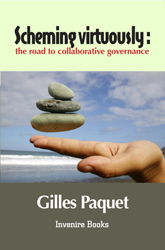
MBR: Scheming Virtuously The Road to Collaborative Governance

I decided I was going to read a book a week for a year, here's a quick review of this week's book.  You can see the ongoing list here.


Basic Info

Scheming Virtuously: the road to collaborative governance by Gilles Paquet


Why I bought it

Actually I didn't, Gilles sent me a copy years ago after having sat on a panel with him and subsequently accepting his invitation to virtuous scheming. Despite my enthusiasm for the book I only wound up reading about half of it at the time as life got in the way (as it tends to do); it's been sitting on my shelf waiting to be finished ever since.


How it connects to the Public Sector

The book argues for a new, more collaborative governance model and points at a number of things that we (public servants, civil society and public intellectuals) could change in order to achieve it. That said, the target audience seems varied and at times the text becomes incredibly complex and frequently invokes Latin and/or French to convey the underlying sentiment.

What I got out of reading it


The best chapters of the book were by far chapters 5 (Stewardship vs leadership) and 8 (An agenda for change in the federal public service), the latter of which tackles the issue of change head on:

"No change will occur if employees continue to perceive that rewards go mostly to those whose policy skills and political savvy are geared entirely to serving mindlessly the whims of their supervisors, irrespective of their capability for meaning-making, their capacity for community-building and their ability to inspire trust and confidence, and to deal with people at all levels." (p198)

The core message being, it isn't enough to simply follow orders blindly, one must speak truth to power at every opportunity.

Cheers

Ps - Sorry for the lack of post last week. It was an odd week and I took my wife to NYC for the weekend so I was naturally a little sidetracked.


Originally published by Nick Charney at cpsrenewal.ca
subscribe/connect
RSS / cpsrenewalFacebook / cpsrenewalLinkedIn / Nick Charneytwitter / nickcharneygovloop / nickcharneyGoogle+ / nickcharney