Friday, May 11, 2012

Like it or not, this is the workplace culture your organization is competing with

I came across this gem via Peter Stoyko's blog; it's the Valve employee handbook. Before I share my thoughts, here is what Peter had this to say about it:
Behold: the employee-orientation manual of the future; except, I hasten to add, this manual is for an extremely successful company from the here and now, the video-game maker Valve. Take particular notice of the forthright language … the lack of finger-wagging “thou shalts” … and the networked, fluid, collaborative model of organisation, including the emphasis on mobile workspaces (a subject I’ve been thinking a lot about in the last few years).

My own hypothesis is (and feel free to disagree) that in a hyper connected world where the expectations of entrants to the labour market are set by market makers (like Valve) your work culture will be the single most important determining factor when considering how to attract top talent. I fully acknowledge that salaries and benefits are important but my experience is that most people I know (at least those who are even marginally entrepreneurial) will gladly trade some of their fixed benefits for more engaging work and all the intangibles that come with it.

If you haven't bothered to read the handbook (you should btw, it will open your eyes to say the least), here is a choice quotation about how the company approaches the issue of hierarchy:
Valve is not averse to all organizational structure — it crops up in many forms all the time, temporarily. But problems show up when hierarchy or codified divisions of labor either haven’t been created by the group’s members or when those structures persist for long periods of time. We believe those structures inevitably begin to serve their own needs rather than those of Valve’s customers. The hierarchy will begin to reinforce its own structure by hiring people who fit its shape, adding people to fill subordinate support roles. Its members are also incented to engage in rent-seeking behaviors that take advantage of the power structure rather than focusing on simply delivering value to customers. (p16)

It's too late for guys (and girls) like me

The worst part of this isn't that I'm working in an alien culture but rather just how further removed from the norm it will be for the next generation should it continue down the twisted path of hierarchy first, everything else second.

At some point, the results we aim to achieve must matter more than the myriad of forms, templates, and platitudes we used to get there.


Originally published by Nick Charney at cpsrenewal.ca
subscribe/connect
RSS / cpsrenewalFacebook / cpsrenewalLinkedIn / Nick Charneytwitter / nickcharneygovloop / nickcharneyGoogle+ / nickcharney

Monday, May 7, 2012

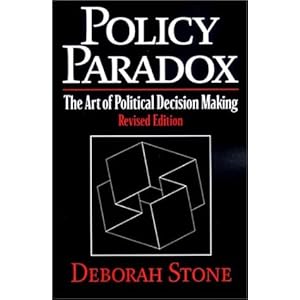
MBR: Policy Paradox: The Art of Political Decision Making

I decided I was going to read a book a week for a year, here's a quick review of this week's book.  You can see the ongoing list here.


Basic Info


Why I read it

It was recommended to me as essential reading by a friend of mine; hell, he even lent it to me!


How it connects to the Public Sector

The book is straight out of a university course on public administration; it deals with everything from multiple understandings of equity to the purposeful use symbols and numbers to define a given issue.


What I got out of reading it


The real mark of this book is its ability to expand your breadth in a structured way without sounding as though it is prescribing policy solutions on either side of the typical left/right spectrum; after all its not often you can pick up a policy book that isn't prescriptive.

Here are a couple of choice quotations, first from the chapter on Efficiency:
"Efficiency is always a contestable concept. Everyone supports the general idea of getting the most out of something, but to go beyond the vague slogans and apply the concept to a concrete policy choice requires making assumptions about who and what counts as important. There are no correct answers to these questions to be found outside the political process. The answers built into supposedly technical analyses of efficiency are nothing more than political claims." (p65, Policy Paradox: The Art of Political Decision Making by Deborah Stone)
And now from the chapter on Symbols:
The strategy of focusing on a part of the problem, particularly one that can dramatized as a horror story, thus is likely to lead to skewed policy. Yet is is often a politically useful strategy. It is a good organizing tool, because it can make a problem concrete, allow people to identify with someone else, and mobilize anger. It also reduces the scope of the problem and makes it more manageable. (p147-148, Policy Paradox: The Art of Political Decision Making by Deborah Stone).
Now, I'd be lying if I said I was done this book yet. As it stands I am only about half way through, but in my defence its a bit thick and there is a lot of meat on the bone. I'll finish it up this week and review the second half next week, but so far I think that Policy Paradox is good reading for anyone interested in public policy (though if you already have a political science degree as I do, some of it may be review).

Originally published by Nick Charney at cpsrenewal.ca
subscribe/connect
RSS / cpsrenewalFacebook / cpsrenewalLinkedIn / Nick Charneytwitter / nickcharneygovloop / nickcharneyGoogle+ / nickcharney

Friday, May 4, 2012

Survivor's Guilt


In case you were wondering, I was not directly affected by Workforce Adjustment (WFA). That said, I can't help but feel a pang of survivor's guilt for those who were (of which I know many); its one of the reasons I took the entire week off.

I should be back to regularly scheduled blogging next week.  

Good luck to everyone affected. 

Cheers


Originally published by Nick Charney at cpsrenewal.ca
subscribe/connect
RSS / cpsrenewalFacebook / cpsrenewalLinkedIn / Nick Charneytwitter / nickcharneygovloop / nickcharneyGoogle+ / nickcharney