Friday, June 15, 2012

What Organizations Can Learn from "If This Then That" (IFTTT)


If you haven't yet heard of "If This Then That (IFTTT)" you might want to have a look. If you are already familiar with it read on, because I think organizations - especially large ones - have a lot to learn from this particular service. 

Here's why.


The premise is simple: if this happens, than do that

The system connects "channels" (Facebook, Twitter, and the like, but also any RSS feed) and then allows users to create "recipes" (ongoing tasks to be performed) by prompting them to set triggers and corresponding actions.


If that sounds complicated, think of it as stimulus=response

If its going to rain in Ottawa, send me a text message. 

If I change my Facebook profile picture, change my Twitter avatar to match. 

If I send an email with an attachment, send a copy of the attachment to Dropbox.


The genius of the service is that it effectively allows you to eliminate any repetitive tasks from your day to day

How many simple repetitive tasks do people in large organizations carry out on a daily basis? 

Wouldn't something that could be easily configured to fill similar gaps within the organizational context be extremely useful?


In a word, yes

If the meeting minutes are approved, send them out to the distribution list.

If I submit vacation, set my out of office reply for those dates.

If I classify a document as Protected A (public domain) in the central repository, create a new GCPEDIA page / append the existing page mirroring the content.


The list of possibilities is endless

On the face of it, you may not think this sounds like much, but in the aggregate these tasks undoubtedly stack up over time. 

IFTTT demonstrates precisely the type of thinking that organizations ought to be adopting whenever they are looking to gain efficiencies. The model, a small front end investment that pays long term dividends, is obviously a compelling one.


On a more practical, in enterprise application, right now kind of solution

Any organization struggling with how to best archive their corporate Twitter presence may want to configure IFTTT to automatically archive their corporate tweets, @ replies, and/or other relevant hashtags by connecting it into Evernote.

Any organization struggling with how to best harmonize their social media outreach may want to configure IFTTT to automatically cross promote content between their social media outposts rather than do it manually every time.

Any organization looking to create a comprehensive overview of an event/conference that they participated in may want to configure IFTTT to grab all of the social media conference proceedings and pump it into Storify.

Like I said, the list goes on and on.


Originally published by Nick Charney at cpsrenewal.ca
subscribe/connect
RSS / cpsrenewalFacebook / cpsrenewalLinkedIn / Nick Charneytwitter / nickcharneygovloop / nickcharneyGoogle+ / nickcharney

Wednesday, June 13, 2012

WRU: Links Worth Clicking

In an effort to again renew the old weekly-round-up (WRU) I bring you a small list of links worth clicking:

Public Sector
  • "Bureaucrats at odds over release of postal code data" http://t.co/ZO5AQ5eR
  • "First wave of 2,200 federal public servants faces layoffs" http://t.co/Z3fwuRW
  • "Fed bureaucrats collected $1.2 billion in severance without being laid off"
  • "Public servants wear grey squares to show solidarity with laid-off workers" http://t.co/78lz1nv4
  • "PM, Privy Council Clerk declare support for bureaucrats to kick off Public Service Week" http://t.co/X8a7YXX1
  • "Public Service Award of Excellence 2012" http://t.co/3poknt7g
  • "Facing the Open Data Templars at GovCamp in Canberra" http://t.co/f1LazAGZ
  • "[UK] Civil servants responsible for policy delivery failures 'to be named and shamed'" http://t.co/KWgCATh4

Varia


Originally published by Nick Charney at cpsrenewal.ca
subscribe/connect
RSS / cpsrenewalFacebook / cpsrenewalLinkedIn / Nick Charneytwitter / nickcharneygovloop / nickcharneyGoogle+ / nickcharney

Monday, June 11, 2012

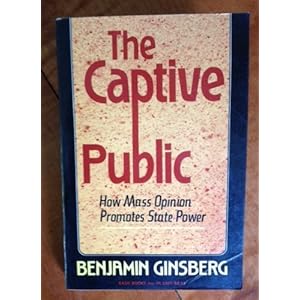
MBR: The Captive Public: How Mass Opinion Promotes State Power

I decided I was going to read a book a week for a year, here's a quick review of this week's book.  You can see the ongoing list here.

Basic Info

The Captive Public: How Mass Opinion Promotes State Power by Benjamin Ginsberg


Why I read it

Sitting on my shelf unread; I acquired the book during my time at university but never got around to reading the entire thing - decided it was time to give it a go. Also, didn't have time to get to the book store and my wife was using her e-reader.


How it connects to the Public Sector


This book was written back in 1986 so obviously it is a bit outdated at this point; that said it does offer a comprehensive history of the evolution of polls in North America and if nothing else is very informative in that regard.

I had a chuckle every time Ginsberg talked about the five "new technologies" eroding traditional (political) organizational strength: (1) polling; (2) broadcast media; (3)  phone banks; (4) direct mail; and (5) professional public relations.

I suppose, in retrospect, I'd consider the book more of a history lesson at this point than something that you can work forward from.


What I got out of reading it


My main take away from the book is best set up by the following quotation:
"... the forces of the political right have continued to be the chief devotees and principal beneficiaries of the new campaign methods. Indeed, the ascendency of the capital intensive technological format means that the balance of political power has shifted - perhaps decisively - in favor of the right. First because of their superior access to financial resources groups on the right will undoubtedly continue to be able to make more extensive use of the electronic media, polls, phone backs, and the other elements of the new technology. As the new political technology continues to supplant the older organizational format that generally favored the left, the political advantage will wing more and more toward the right." (p.174)
In the surrounding pages, Ginsberg makes the argument that the political right is better at raising capital and thus exploiting new technologies while the political left is better at organizing people at the grassroots. As a result, Ginsberg argues,  the political right will continue to introduce new means of mobilizing public opinion while the left will continue refine those methods and thereby produce greater efficiency downstream. One could consider the success of the first Obama presidential campaign in the United States as evidence of just that type of refinement.

All in all, I wasn't thrilled with The Captive Public, but if nothing else it was a significant lesson in history; and we all know the old adage about that one.

Cheers.


Originally published by Nick Charney at cpsrenewal.ca
subscribe/connect
RSS / cpsrenewalFacebook / cpsrenewalLinkedIn / Nick Charneytwitter / nickcharneygovloop / nickcharneyGoogle+ / nickcharney