Showing posts with label complexity. Show all posts

Friday, December 1, 2017

Simple Thoughts On Policy Complexity


by Nick Charney RSS / cpsrenewalFacebook / cpsrenewalLinkedIn / Nick Charneytwitter / nickcharney

Yes, the world is complex.

Pursuing a given public policy objective (i.e. an outcome) brings that complexity into view; and bringing that view into focus, by gathering information and weighing evidence and opinion, means drawing boundaries around the issue(s) in imperfect ways.

This imprecision has real world consequences. Draw the boundaries too wide and it can produce paralysis by analysis, draw them too narrow and you can end up with governance by gut feeling. Neither of which are ideal, and both can have profoundly negative consequences.

Complexity is really about spillover from one policy domain to another. Determining a logical order or hierarchy isn't always possible because none of the issues can be isolated from those that are adjacent. This complexity is further complicated by the fact that spillover is both omni-present and omni-directional and in a constant state of flux.

This leads me to conclude that the crux of the challenge facing policy makers is calibration; it's about knowing who and what to include and, where where to draw the lines, understanding the inherent consequences and trade-offs, and being willing to accept them.

When trying to solve for especially pernicious problems this becomes exponentially harder because the conventional wisdom is that their solutions lie in the innovation of the adjacent possible (i.e. somewhere in the messy spillover). The same conventional wisdom argues that you ought to spend 95% of your time defining the problem and 5% solving it. That means not only are you actively pursuing work in the messier parts of the problem set you are also spending the bulk of you time calibrating and re-calibrating within it as the landscape continues to shift around you.

I guess its not so so simple after all.

Tuesday, April 18, 2017

Deep dives, or long drags

by Kent Aitken RSS / cpsrenewalFacebook / cpsrenewalLinkedIn / Kent Aitkentwitter / kentdaitkengovloop / KentAitken

The idea that problems are increasingly complex is incredibly common. It's taken as a truism. If that's the case, why haven’t we reorganized our institutions to deal with it?

*****

A quick story. In March I was at a Tamarack conference on community engagement, and I was struck by the design details of the event.

There were no panels, no real keynote speakers, and no “big names” as hooks. Most of the conference programming was led and delivered by three experts from Tamarack. It was more like a curriculum than a conference; they clearly spent a lot of time deciding on what participants needed to learn and preparing sessions to get it across. It came with a textbook-length package of tools and further reading. To some extent this is a luxury of small events, but I’ve seen it done well with 300 people, too.

This is what we’d expect of that organization; Tamarack's business is designing and facilitating collective learning and decision-making processes. Their President, Paul Born, used an example about being approached to facilitate the development of a homelessness reduction strategy in one community. The process he designed was a 2.5 day session with the key actors in the ecosystem, including senior leaders from government, NGOs, and business. He considered it the minimum amount of time required to work through the issue, have participants meaningfully reflect, and to build commitment to action.

At this point I’d like to contrast this with what I’d consider the standard approaches. Conference panels that work more like back-to-back short presentations, often without trained moderators, that barely scratch the surface of an issue. A universal meeting format of presenting an issue followed by discussion and decision, 20 minutes tops. A premium on brevity and simplicity in written materials.

Our group knowledge transfer and decision-making systems are, unequivocally, not designed for complexity.

I suspect that the common reaction to the idea of getting the 100 most influential people in a system to work through an issue for 2.5 days would be that it’d be impossible. That’s way too much time. Which is exactly what facilitators, designers, and consultants hear. “Can you help us do this?” “Yes, and it’ll take X amount of time.” “That’s too much, it has to be a half day max.”

We give lip service to the idea of complexity, but we certainly don’t behave like we appreciate it. If a given issue is complex, then it requires a deep dive and sustained attention. But if every issue brief is two pages, it’s hard to tell the difference between those that should be two pages and those that should be a book.

At which point I’m sure someone will tell me to be practical. Executives don’t have time to explore issues for 2.5 days or read long briefings. And of course I agree, but it’s exactly the problem*.

And here’s the result: instead of deep dives, we do long drags. It’s when you find a four-month project creeping into 18-month territory, and one more month doesn’t seem like much of a big deal. It’s when you realize that you have to scramble to bring stakeholders to the table that you hadn’t originally identified. It’s when you’re sending just one more briefing up, or having just one more meeting, to work out an issue with a proposal. It’s why everyone is comfortable with the oxymoronic word “reconfirm.”

This is very different from, say, agile software development. In that case, the complexity and constant iteration is scoped, planned, and designed for. But for these long drags you underestimate the amount of time and effort required, and uncover and resolve issues as much by accident as by system.

Complexity is a defining feature of the digital era, and we are not adjusting our governance structures to manage it. Just the opposite, in some ways: as authority and information became distributed and hyperconnected, the pressure towards centralized decision-making and message control became stronger. Governments have grown by orders of magnitude since we developed our conceptions of accountability, and we’ve increasingly realized that the sharp lines between issue areas are more porous than we once thought, making them effectively much broader. If your portfolio is health, it’s also education, social security, and the economy.
What hasn’t grown is the time, tools, or resources to deal with boundaryless problems with many stakeholders: everything from the most intractable policy problems to building user-centred digital services. You need deep dives, the time to do things right, and people empowered to test ideas and work across organizational lines.
To do it, governments will need to either free up senior leadership from day-to-day issues, or push authority further down the chain**. If they aren’t willing to - which is, admittedly, a reasonable position - then the appropriate conclusion is to revise expectations downwards: for the ability to solve wicked problems, collaborate between jurisdictions, or rework internal systems to create more coherent public-facing services.
I may be naive for thinking that this system can be changed, but we’re all naive if we think we can get better at dealing with complex problems if it stays the same.


*Every project lists senior executive commitment as a success factor, which is a resource that doesn't scale up with complexity. At which point it's worth noting that executives tend to overestimate the success of corporate initiatives, and underestimate the scope of organizational problems; executives are already spread more thinly than they think.
**I'd consider the Codefest events that brought internal and external communities together to develop the Web Experience Toolkit to be a shining example of both designing an event to make progress on complex work and of working-level employees having the authority to lead it.

Wednesday, December 21, 2016

Collaboration takes time that organizations don't have


by Kent Aitken RSS / cpsrenewalFacebook / cpsrenewalLinkedIn / Kent Aitkentwitter / kentdaitkengovloop / KentAitken

A couple years back I wrote about a vicious cycle of centralized decision-making and the what it meant for executive attention on important issues. I don’t think there’s a single major issue in large organizations that doesn’t, at some level, stem from the meta-problem that the demands on executives’ time are incredible. At some point in the dissection of every systemic issue you could include “And executives don’t have the time for it.” Every major new initiative includes, as a factor for success, “senior executive support.” 

I’ll recreate the same model because I think it’s still interesting. Today I’d add organizational design and I’d probably fingerpaint it, but I think it mostly holds up.


The long story short is that more time spent on content means less time on process, including coaching, big-picture thinking, and organizational design. Which ultimately leads to the need for even more centralized decision-making in the absence of experienced delegates and effective governance. 

The compounding problem is that executives are structurally hamstrung from recognizing and correcting this pattern. Throughout an organization, there will be some sub-organizations with a manageable workload where everything gets dealt with. However, from the top, those organizations will look the same as those where things are falling through the cracks. Some issues that would otherwise be important will remain invisible because there’s no time to make them visible. And your delegates will start curating demands on executives' attention on their behalf out of sheer practicality - and from a smaller-picture lens - removing the ability for pattern recognition.

That is, for someone running at 100% capacity - as in, an actual maximum at, say, 80 hours per week - they’ll never know if the amount of work that should, given current systems, require their attention would actually add up to 120 hours per week. The extra 40 hours of work is impossible to see.

From the ground floor, this often results in issues that are paradoxically so important that they can only be resolved by [X] level of executive, but so unimportant that they won’t possibly make it to that level in the absence of good luck or a media article that catalyzes attention. 

When this problem exists in an organization, people probably don’t - and can’t - know the extent of it. 

Right now I'm doing work on digital-era governance, and there are recurring themes: collaboration, systems thinking, user-centricity. But collaboration takes time - particularly when we're talking about formal, long-term collaboration between organizations or even orders of government - and time is already an incredibly stressed resource, in ways that are very difficult to fix.

Wednesday, March 18, 2015

How Organizations Plan, and Why It Shouldn't Be Institutionalized Advice


by Kent Aitken RSS / cpsrenewalFacebook / cpsrenewalLinkedIn / Kent Aitkentwitter / kentdaitkengovloop / KentAitken


The last couple posts have been working through a question about how organizations plan. The long story short:
  • We've institutionalized oversimplification (a symptom being the "Elevator Pitch")
  • Correcting that oversimplification is likely an unrealistic goal
  • The solution (according to Charles Lindblom) is letting policy decision-makers throw rational planning out the window and "try stuff"
  • To avoid unfairness, policy proposals will be closely watched by an ecosystem of stakeholders: groups responsible for related goals in government, lobbyists, NGOs, and think tanks
On the surface, this sounds like the zeitgeist: experimentation, innovation, and collaboration. However, the "try stuff" here refers to large-scale national policy, not pilots: "trying stuff" on, say, tuition subsidies has a massive impact on people's lives. And the role of that "ecosystem of stakeholders" isn't collaboration: it's recommendation, or advice.


Recommendation-Based Governance

In the last post, I linked to Yves Morieux, who breaks down the economics of multi-stakeholder decision-making: where one person owns the decision, but not the inputs required to make it. He paints a portrait of a car manufacturer, in which the lead designer must satisfy the organizations' experts in noise reduction, fuel efficiency, repairability, safety, and much more. It's easy to imagine how fuel efficiency and safety could be at odds: do you make a car lightweight, or an urban armored personnel carrier? So we have a designer, whose bonus but not core salary depends on performance pay that is based on competing goals decided by 26 different people. Which makes their incentive to care about any individual one of those goals very close to zero.

Recommendation-based systems do nothing to address the asymmetry between the incentives of those involved. Put simply: recommenders don't get paid to contribute to the best outcome. They primarily get paid to promote the variable they represent, as loudly and voraciously as possible. They do not get paid to look for compromises, concede when others make valid arguments, or even to develop long-term relationships and credibility. In the above example, the safety expert's concern is chiefly to understand the optimal outcome from a safety perspective; it's the designer's job to worry about how to square that with fuel efficiency. 

Why is this? It's partially innocent bias: people care about what they know about. I'm sure far more than 50% of the population thinks their expertise is of above-average importance. But more so, it's that the people that hold recommenders to account are a step removed from the decision space themselves, and likewise rely on oversimplified elevator pitches for setting goals. It doesn't help that recommenders rarely receive any feedback about the results of their role in the decision.

Recommendations exist in a partial vacuum, whereas decisions exist in an ecosystem. 

So what's the solution? Morieux proposes six elements (paraphrasing):
  1. Ensure that players in the ecosystem understand what the others do
  2. Reinforce integrators
  3. Remove layers
  4. Increase the quantity of power so that you can empower everybody to use their judgment
  5. Create feedback loops that expose people to the consequences of their actions
  6. Increase reciprocity, by removing the buffers that make [people] self-sufficient
In other words: make people meaningfully responsible for the outcomes of their work, make people responsible for collaboration, and make sure they can see and understand the ecosystem.

No amount of communication or planning can solve this issue entirely - the change has to come in how power is distributed and used.

Wednesday, March 11, 2015

Rational Planning or Muddling Through


by Kent Aitken RSS / cpsrenewalFacebook / cpsrenewalLinkedIn / Kent Aitkentwitter / kentdaitkengovloop / KentAitken


Last week's post was about how organizational language, culture, and processes encourage the oversimplification of both problems and solutions (see: Boundaryless Problems and the End of the Elevator Pitch). It makes it easy to ignore the context of problems, and hard to appreciate the indirect or long-term benefits of any action.

(I've written in the past about how this hampers innovation and restricts collaboration, and proposed strategies to overcome it. Further back, I wrote a deeper dive about its adverse effects. I'll stop hammering on this theme soon.)

But after writing the post, I kept wondering if the idea was remotely useful to on-the-ground public servants. So, we tend to oversimplify things. Is that a necessary shortcut? Especially given the competing demands on our time? Or a lens that can help improve our planning? I'm not sure.


There are a few possible scenarios for this "ecosystem of problems and solutions" lens:

  1. It's false
  2. It's true, but useless
  3. It's true, but only useful in some situations
  4. It's true, but requires a particular response to be useful


No plan survives contact with the enemy


I want to dig into 2 and 4, starting with 2. It's true, but useless. Yes, there's an ideal state, in which we tackle a given problem exactly the way we should. But day-to-day, there are multiple problems, approaches, and solutions competing for our time and attention (see: Idealism and Pragmatism for Organizations). Maybe an 80% effort is less than ideal for a given problem, but best for the portfolio of problems we're facing.

Paul Wells led us to an interesting possibility for 4. It's true, but requires a particular response to be useful in his book The Longer I'm Prime Minister. He pointed to Charles Lindblom's The Science of Muddling Through, the long story short of which is that yes, public policy is impossibly complex (zero hyperbole), so the only way of understanding one's own preferences is actually to choose a direction and run with it. It's ten pages long, and I highly, highly recommend reading it - first for the above, and second to note that the verbiage of "complex public policy problems" is not a new phenomenon based on modern global finance, terrorism, or digital interconnectedness. It fits as easily in this 1959 paper.

Lindblom's take would be that there's much merit in experiential knowledge and large-scale experiments in the form of jurisdiction-wide policy changes. Skip the theories, frameworks, and mutually-agreed upon goals. If you think big enough, everything can be an experiment (e.g., the 10-year tax breaks in the US).


Oversight and Results


However, I think that Lindblom's solution is insufficient. One, governments have a certain responsibility towards fairness, even at the cost of efficiency. The human impacts of experiments cannot be ignored. For instance, in both the UK and Greece, social scientists have linked austerity policies with increased suicide rates (see: this post on the importance of good public policy). And in the age of transparency, governments cannot just make backroom trades of fairness for effectiveness (see: The Social Contract). 

Two, Lindblom suggests oversight in the form of multiple actors with competing interests: watchdog groups, lobbyists, and other responsibility centres within government. However, as Yves Morieux has pointed out, when someone has multiple people lobbying them, the marginal cost of ignoring any particular one of them is pretty low. Worse, none of those lobbying are paid to lobby for good systems overall; they're paid to adamantly recommend the solution that maximizes the variable they represent.

So where does this leave us? If I'm to be believed, both rational planning and experimentation and oversight are flawed approaches to public policy, which is not particularly inspiring. But I'll  let it hang for today and pick it up again shortly.


Wednesday, October 1, 2014

Efficient vs Effective

by Kent Aitken RSS / cpsrenewalFacebook / cpsrenewalLinkedIn / Kent Aitkentwitter / kentdaitkengovloop / KentAitken

Government is constantly advised towards greater efficiency. I think we need to become far more conscious of the word "efficient."

Efficiency is the hallmark of the industrial era and modern capitalism. It is the great boon of the division and specialization of labour, of economies of scale, and its pursuit has done wonders for our standards of living. Efficiency is the only reasonable approach in a world of finite resources, and in the era of knowledge work, we must largely discard it to actually achieve it.

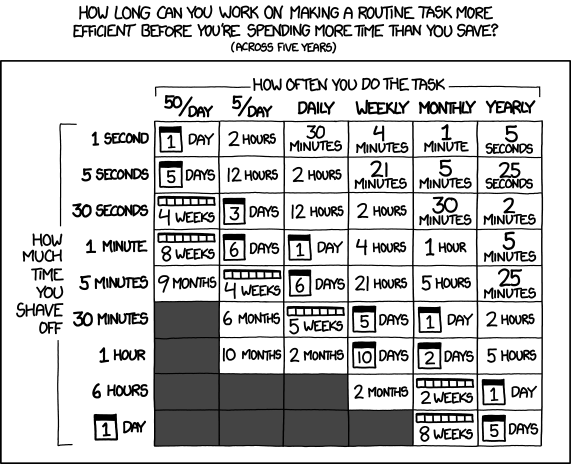
Largely. If we can spend a few extra minutes finding a better way to do something more efficiently, such that we save more in the long run than we invested in the improvement, we should. For example, making an extra phone call and finding a place that will print ads for 10 cents per page, rather than 12. Or taking time to learn a faster way of designing the ad layout. XKCD conveniently mapped that cost/benefit analysis for us:


However, it's impossible to run the entire ad campaign efficiently (regardless of research suggesting that the efficacy of online ad campaigns is still frequently a mystery). Because the entire campaign is driven by actions taken long before it starts, before we start poring over data from A/B testing. Can we run it effectively? Yes. But the knowledge of the people running it, the relationships between them, the mentor that encouraged the copywriter to stay in their job? We can't capture that complex system well enough to navigate it efficiently.

A colleague can efficiently, at 60 wpm, type us an email warning us of a major problem coming down the pike. But it might not be efficient in the context of their mandate, and we certainly didn't worry about efficiency building the relationship with that person. Coffee meetings aren't, at the individual level, very efficient.

But at the organizational level, coffee might be the killer app. Even 12-person lunch tables are more effective for software developers than 4-person ones, in that they lead to less compatibility issues in the code.

Even the potential of the digital era to feed us the information we're looking for algorithmically is increasingly driven by human relationships: what the people we interact with are reading, who are we following, and who can we trust to act as amplifiers and filters.

ConocoPhillips reports that they've saved $100 million by encouraging employees to help each other solve problems. At the macro level, it's clearly "efficient". At the individual level, hardly.

We can't take an efficient approach to knowledge work. It's too complex. Instead, we have to trust ourselves and rationally apply macro-level knowledge, such as that collaboration works for organizations. Even when it's hard to see how it serves the pressing needs of the individuals within the system.

The factory-driven logic of efficiency may still apply to tasks and processes, but even there the logic is messier than you'd think. What if a theoretically less efficient system gets more use because it better matches the culture of a community? Or because it has buy-in, having been developed locally?

Digital interactions with government are an easy efficiency win. Filling out health care paperwork online is a far cheaper, quicker transaction for both parties, but what if the visit to the office creates the opportunity to discuss an emerging health concern? Expensive in-person contact with health care professionals is often worth it, in keeping people from needing even more expensive hospital stays later. In a few years we may be working on how to strategically get people through government doors at key intervals to bolster a digital by default strategy.

Knowledge work is a relational game, and we need to tread the language of efficiency cautiously. When combined with inevitable oversimplification and incentives designed for parts, not wholes, efficiency just isn't effective.

Friday, September 5, 2014

Process and Public Service Renewal

by Kent Aitken RSS / cpsrenewalFacebook / cpsrenewalLinkedIn / Kent Aitkentwitter / kentdaitkengovloop / KentAitken

Just a quick post today. I was on the road most of August and am still mostly just catching up.


A few weeks back I wrote about The New Nature of Process, the idea that that organizations are at a pivot point akin to industrialization. But where that revolution occurred by standardizing and repeating processes for material goods, we're looking at standardizing and repeating processes for human learning in the context of complex problems. All optimized for efficiency, fitted within governance and business cycles.

(Albeit with a broad view of efficient. Sometimes expensively sending a nurse practitioner to someone's house is, in the long run, more efficient than optimizing the process within the hospital they'd otherwise visit.)

Let's call it standardizing processes for exploring and solving complex problems. At the time I considered it an interesting idea, a possible trend. But after thinking about it for a bit I realized that if it's true - that is, if we're just getting started but can get far better - it would assuage the doubt I feel about public service renewal. Even the elements of it that I personally support and suggest.

For instance, in the past I've wondered if a public service characterized by trust, decentralized decision making, and engagement is unrealistic or undesirable. If such a state only works well in marginal cases, such that the success stories for that approach actually represent most of the fertile ground. Or, after Chelsea highlighted some of the more negative possibilities of loosened hierarchy, I wondered if the style of management I considered ideal was too unreliable across a critical mass. That it would work well only if it was the only thing managers had to worry about (it isn't). Or take Hugh Segal's recent take in the Ottawa Citizen, about the need for stronger managers, less management layers, and more leeway for frontline decision making.

I generally favour these approaches, in a vacuum. But the real world is messier. However, if we can significantly and reliably accelerate employees's sensemaking of complex environments, such approaches may be very manageable in the real world.

And the sensemaking tools are there. How to map a network of stakeholders, how to help them (and you) understand each other, how to suss out side effects of policy, program, and service decisions. The question now is one of optimization and repeatability.