Showing posts with label renewal. Show all posts

Wednesday, November 30, 2016

Public Service: The Long Game and the Dark Side


by Kent Aitken RSS / cpsrenewalFacebook / cpsrenewalLinkedIn / Kent Aitkentwitter / kentdaitkengovloop / KentAitken

I’m optimistic. About the public service, its mission and work, and my role in it.

Teresa Amabile analysed journal entries for months from 238 employees in 7 countries, and determined that the singular difference between a good day and a bad day for a professional is whether or not they made progress on meaningful work. That’s it. Just that they got to do their job, and they felt that it meant something.

We can zoom out and look at Corporate Executive Board’s research on employee engagement. They didn’t get into journal entries, but surveyed 11,000 employees around the world and came to a similar conclusion: the number one driver of employee engagement is the sense of connection between what you’re doing and the organization’s mission.

And if I wanted to really hammer the point home, Gallup did a meta-analysis - an analysis of other analyses - of 1,390,941 employees. Same thing. Connection to mission comes out as the number one driver.

This kind of engagement is emotional. It’s something you feel, day to day.

Which is sometimes hard to reconcile with a mission of long-term stewardship.

In the public service jobs are, by their nature, part of a long-term mission. Political parties come and go and we stick with the ship of state. In Canada our senior civil servants are modelled after “Permanent Secretaries” in the UK, charged with making sure that departments function smoothly through political changes. The values and ethics code includes Stewardship and Respect for Democracy as pillars.

Although you’d be more likely to hear those pillars interpreted in the news as “risk-averse” or “slow-moving.” Thick skins required.

For individual public servants, this grandiose role of stewardship gets broken down, then broken down more, into day-to-day tasks. Sometimes this is exciting and engaging, and sometimes it is decidedly not. But it’s all a part of something bigger. Public service is about the long game.

When I first started in the public service, I admittedly wasn’t incredibly excited about my job, for the most part. I sat in my cube wondering if I could do this for the rest of my life. Eventually, I decided I’d stop worrying about it, and did the most bureaucratic thing possible to do so: I set an appointment in Outlook to worry about it later, on my three-year anniversary of public service employment.

This was a mistake.

As it turns out, the three-year mark is when you’re statistically likely to hit rock bottom for engagement in your career. For your first three years you’re full of enthusiasm, ideas, and idealism. But then you start running into obstacles, limits, and the realization that as a public servant you don’t get to do everything you want, or even all the things you think are in the public interest.

And to be honest, I was wrong a lot. Many of those obstacles are purposeful and useful, and they are, if nothing else, democratically legitimate. But it doesn’t mean it still doesn’t hurt a little when you run into them.

This is the dark side. You can rationally appreciate the long-term calling, but you still want the emotional day-to-day engagement.

So what happens to your level of engagement as time stretches towards the end of your career?

You start getting more responsibility, more control over outcomes, and more involved in the bigger mission of the organization. In fact, executives (in general, not necessarily government) tend to be the most satisfied with their jobs. I’ll stress tend - I have immense concern and sympathy for the all-too-real and prevalent mental health challenges for many over-taxed executives. The satisfaction is not universal, and the distribution is more interesting than the average. 

But for young public servants, that’s ages away. It’s hard to think about where you’ll be, and if you’ll be happy, 20 years from now. I mean, you should be happy now. 35 years of service would put my retirement date at May 5, 2044.

2044.

That is hecking terrifying. That is a date that only ever crosses my consciousness in science fiction. Even Star Wars happened before then.

Of course, it all depends on how we look at it.

Here’s some homework. Take out a sheet of paper and write the date ten years ago. November 30, 2006. And start making a list of everything you know how to do now, everything you understand, everything you’re good at, that you weren’t, then. That you’ve learned in the last decade.

It’ll be a long list.

Think about all those things, then start imagining what’s possible in the next ten years. The next 20. The next 30. That’s your horizon. Don’t worry about specifics, now, just the overall potential.

I, for one, am very excited about what is possible over this long horizon. The kinds of projects I’ll be able to contribute to, and the kinds of meaningful progress we’ll be able to make, individually and more importantly, together. I can look at that 2044 date and think “I’m going to get to work on so much amazing stuff by then.”

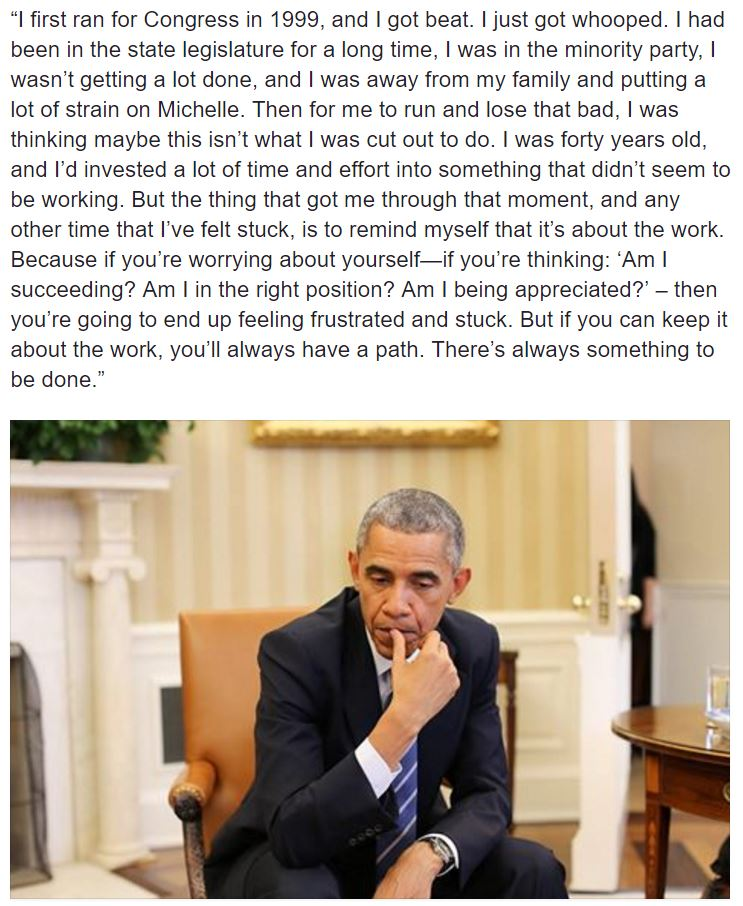
Listen to this man:

Jen Palhka, founder of Code for America and former White House Deputy CTO, said that to work in government you need to hold two contradictory thoughts in your head at once. “You need to love government, yet want to change it.“

The problem with thinking about change in fiscal years, or even three-year stretches, is that nothing happens. Ever. It’s like the turtle that keeps on getting halfway to the finish line, but never quite reaches it.

Even three years is too short for massive changes unless something breaks. Public servants are here to be stewards, the steady hand on the wheel, but that means the job is to keep things from breaking, not wait for turmoil to ensue when it does.

But the crazy thing is that they actually do happen. New Public Management actually happened. That’s a massive change. And now, of course, we have to un-change it, and that’s a nightmare. But it happened. The public service is capable of significant course changes.

Public servants don't get to scream what they think. But they're close to the fulcrum of the levers of change. When the lever moves, it can have a lot of impact for a lot of people.

Interpret that as both reward and duty.

At many points you will be the ones with the hard decisions. It’ll be up to you to think about stewardship and respect for democracy and to not say no because it’s easier than saying yes.

If you forget how important your job is, it will immediately become unimportant.

If you forget how much is possible, many things immediately become impossible.

If you ever say “it can’t be done”, or “there's no appetite for that,” you'll be right, because you just made it that way.

It’s about the long haul, not the quick wins. That’s the mission to connect to. When you feel like you’re missing that piece on any one day, remember the long game.

Wednesday, June 22, 2016

A quick stock-take on public service renewal

by Kent Aitken RSS / cpsrenewalFacebook / cpsrenewalLinkedIn / Kent Aitkentwitter / kentdaitkengovloop / KentAitken

Last week I almost wrote a post just to announce a hiatus for the summer. I’m getting into the home stretch of an MSc dissertation. A break would be a little about freeing up time, but at least as much about A) simplification of my weekly to-do list and B) trying to keep some semblance of a quality standard in my writing. I think I’ll stop short of a full hiatus, and just apologize for sparse posts for the next few months. Which probably feels to me like a much bigger deal than it is, but I like the weekly rhythm.

I’d like to keep it up because I do feel like writing these days. There’s a ton going on around the public service that is inspiring me lately and bouncing around my head. In 2012 I wrote about possibilities for tectonic change in the public service, and I’m starting to feel like some of those ideas are becoming real. Not for any one reason - it’s many things lining up and coming together.

When looking for something like “culture change,” it’s sometimes hard to differentiate between what’s actually different and what you, yourself, are seeing differently. It’s inevitable that the longer you've been around, the more you’ll see of everything: the good, the bad, and the ugly.

And with that massive bias in mind, I’m still more optimistic about the future - this whole 
“public service renewal” thing we keep banging on about - than I have been for a long while. I’m thinking of things like digital service redesign (maybe with some friendly competition from Ontario’s soon-to-be-minted Chief Digital Officer), citizen engagement on policy making, and more opportunities to work with the private sector and civil society - including more opportunities for civil society to hold government accountable to outcomes.

Part of the interest here is the potential to get out of our comfort zones a little bit and experiment with different ways of doing government. But there’s a value proposition much deeper than “experiment and we’ll see if it works” here. One of the threads that connects digital service, citizen engagement, and government releasing more information is that whole accountability piece: people and organizations having more information, and more avenues, to put pressure on government. Which will have its bad sides as well, but if nothing else will nudge government towards more honesty and authenticity.

I’ve felt the conversations - and communications products - changing over the last few years. It’s harder to respond with talking points to people who can talk back.

And, it’s harder to respond with talking points to people who you really understand and empathize with, which is one of other connecting threads. I’ve made this point before, but here it is a tad more bluntly: whether or not a given public servant truly understands their stakeholder communities may be the single biggest factor influencing their perspective on their work.

Jared Spool’s research on usability and design keeps coming back to this magic number: 2 hours every 6 weeks interacting with the end users of a thing. For everyone who influences the design (that includes senior executives) I’d argue that this principle would apply to a surprising range of things: products and websites, but also policies, service interactions, and communications.

The good news is that we’re all increasingly becoming front-line public servants.

Which means that not only are things poised to get better, but poised to get systematically better, which is the real kicker.


Wednesday, February 17, 2016

What has changed?

by Kent Aitken RSS / cpsrenewalFacebook / cpsrenewalLinkedIn / Kent Aitkentwitter / kentdaitkengovloop / KentAitken

Yesterday morning was pretty mild, but there was a storm watch in effect and a couple colleagues had emailed to say they were working from home. They were the people I’d have meetings with at work, so I set up a videoconference with screen-sharing for later that morning and stayed home too.

That’s not rocket science. Skype came out in 2003, and the Government of Canada has had WebEx accounts since before I joined in 2009. But in 2009 I wouldn’t have had email on my mobile to coordinate the meeting, wouldn’t have had access to documents at home, and I might not have been a contender for a WebEx account. Plus, as recently as last year I had a manager who generally just preferred to have everyone make to the office if they could.

It’s a relatively minor thing. The worst case scenario would have been a teleconference, or a delayed start so that people could get to the office. But it’s something that is simply different, culturally and technologically. Looking back, it’s something that has noticeably changed about my public service day-to-day.


Change isn’t quick


Way back on April 13, 2013, I wrote my first post on CPSRenewal.ca, titled What You’re Giving Now? You Can Never Give less. The idea was that today is your baseline for how much you’re contributing to your work, and your contribution is just going to keep getting more important. But you’ll be up for it.

At that time, I had just gone through an exercise of jotting down everything I had learned in the last five years and was surprised at how lengthy the list was. Really surprised. Our experience, knowledge, and competence build almost imperceptibly day over day, like children age, and it’s only when it’s brought to our attention do we realize how much has changed. It’s the same for the public service. For example, we collectively just did this exercise for the history of online communities in the Government of Canada (hat tip to Ryan Androsoff).

CPSRenewal.ca is about, well, public service renewal. How things keep changing. Sometimes, people talk about change or even make structural changes - and culture eats it for breakfast. Other times, without any particular guidance, things slowly shift and settle into a new equilibrium. Typically on this blog, I dissect those things that I think are changing too slowly. But if we started to list the changes, I think we'd surprise ourselves at how long the list would be.

What has changed?


My original plan was to pose the question purely rhetorically, but I'll add a more tangible option as well. I’ll invite you to add anonymous or attributed anecdotes in this What Has Changed doc, and I’d also welcome stories in the comments.


Tuesday, September 29, 2015

The Ship's Doctor, Or, the Difference Between Skill and Expertise

by Kent Aitken RSS / cpsrenewalFacebook / cpsrenewalLinkedIn / Kent Aitkentwitter / kentdaitkengovloop / KentAitken

This is a quick reflection on HR and the difference between skill and expertise, but let's start with Firefly.

The show Firefly followed a crew of spaceship smugglers, each with a distinct role on the ship: Malcolm, the Captain; Zoe, the first mate; Hoban, the pilot; Inara, the "diplomat;" Jayne, the mercenary; Kaylee, the mechanic; and Simon, the ship's doctor.

The thing is, they only have so much room on board, and they only make so much money. And every additional crew member reduces the percentage of profits for the others - it's expensive to keep people on.

Therein lies the problem with the setup. Everyone pulls their weight, but it's a pretty crude division of skills: the only options for medical care, for instance, are to have no doctor or a full-time doctor as part of the crew and cut of earnings. In the middle of space, there's no scaling to needs. Everyone else could learn some field dressing and first aid, but it's a far cry from a trained, professional surgeon when you really need one.

The analogous situation for an organization's HR is the question of whether you find specialists or train generalists in new skills. The example that came up recently was about facilitation, and a colleague and I discussed the difference between a moderator - someone who can keep a conversation moving productively - and a trained facilitator, who can design a productive session and get the absolute most out of the brainpower in a room. But there are many such fields: data analytics, engagement, usability, research techniques, and on (or anything that fits the model described in the post Innovation and Rigour).

The problem is that very few teams, staffed permanently with a particular crew with a particular set of skills, need a full-time facilitator. But they also don't need everyone trained lightly in facilitation - it's like the difference between first aid and surgery. What these teams need is reliable, scaleable access to a surgeon when someone gets badly injured. Or, less darkly: reliable, scaleable access to specialized, expert skills on demand. For example, one would only bring in a facilitator when they host major meetings or workshops, or during strategic planning exercises.

The alternatives are dicey. To a point, a culture of collaboration solves the dilemma. But that requires that enough teams have these mutually dependent features:
  1. They've identified a need for specialized expertise
  2. They're willing to fill a valuable, rare open position with that particular expertise
  3. They have enough flexibility to lend that person, on demand, to other teams
Which is unrealistic at worst, and unreliable at best.

Otherwise, there are several models proposed to solve this dilemma: Govcloud or STRATUS, both of which require a bank of expert employees who are not permanently bound to any particular program or set of deliverables. It's comparable to the "corporate services" approach (HR, finance, IT, procurement) but for non-standardized work, where expertise meets policy and program knowledge.

Regardless, the status quo has a gap that most organizations currently cannot appropriately address. But it's the world we inhabit: incredibly high standards for program and service delivery, with increasingly niche approaches to getting there, that may not fall neatly into 40-hour-per-week job descriptions. Have people squared this circle? Are there any other approaches that are working well?

Wednesday, March 4, 2015

Boundaryless Problems and the End of the Elevator Pitch


by Kent Aitken RSS / cpsrenewalFacebook / cpsrenewalLinkedIn / Kent Aitkentwitter / kentdaitkengovloop / KentAitken


I've always been terrible at elevator pitches. My stock answer to most questions is "It depends". When people ask me "What do you do?", I tend to respond with a couple questions to gauge their level of familiarity with government. Providing succinct value propositions has never been my thing.

Last year a handful of us organized a talk and facilitated workshop with Joeri van den Steenhoven, Director of the MaRS Solutions Lab. While bouncing the idea off people, we were asked "What's the desired outcome?" My response was that it would be a combination of outcomes, and that it would be different for different people:
  • learning about social innovation
  • learning approaches to tackling problems
  • practice teaching and facilitating
  • meeting potential collaborators
  • generating ideas for follow-up

Which, I think, is reasonable. But we still ask for elevator pitches, and still demand a blindingly obvious causal link between solutions and problems. It's one of the 10 Tricks to Appear Smart During Meetings: asking "What problem are we really trying to solve?"

To be honest, I think it's an incredibly useful question - but perhaps insufficient. For public policy, the likely better question is something like "What environment are we trying to influence?"

In the interest of pragmatism, when someone asks you for an elevator pitch, you should probably have one ready. But I think it's in our best long-term interests to move away from that fiction about policy. This world doesn't actually exist:


It's more like this*:


Except:
  • the bubbles are all constantly moving around
  • the bubbles are always changing size and shape
  • not everything on the environment side is a problem
  • not everything on the effects side is positive
  • this diagram looks at least slightly different to every different player who cares about these problems and solutions
Last week Canada 2020 held a Big Ideas session, at which former Deputy Minister Morris Rosenberg pitched a governance rethink as a Big Idea, citing problems and solutions without clear boundaries in time, space, or definition as the burning platform. Don Lenihan's recap is worth a read.

This prescription isn't easy. Governments have duties pushing from the other direction, including to prove the success of their interventions, and to communicate accessibly with citizens - there's friction against wonkspeak about complex problems. But we can at least stop reinforcing the false expectation of easy answers by asking for and providing them, and recognizing the red flag when we hear them. 


*Venn diagrams are one of the other tricks to appearing smart.

Note: nothing I write on CPSRenewal exists in a vacuum. In this case, thank you to John Kenney, Blaise Hebert, and Abe Deighton for the conversation and ideas.

Another note: there are some parallels to this post on short- and long-term thinking; the issues stem from overlapping incentives for government.

Friday, October 10, 2014

Why the Sharing Economy is Inevitable and We Need to Think Differently


by Kent Aitken RSS / cpsrenewalFacebook / cpsrenewalLinkedIn / Kent Aitkentwitter / kentdaitkengovloop / KentAitken


Last week Uber launched in Ottawa. It's a smartphone-based ridesharing platform that is structured more like a taxi-passenger relationship than a carpooling forum. Drivers got dinged with fines, Uber found workarounds, and we'll see where things stand once the dust settles.

Uber's one of many examples of the sharing economy, and it's one of the brands that has become a lightning rod for attention. For hospitality, it's Airbnb. Kijiji also fits this model, which is sometimes called collaborative consumption or the peer-to-peer economy.

Regardless of the virtues and problems people see in the sharing economy (often fairly, in both cases), here's why I think Uber and its ilk are inevitable, and why Uber is the latest in a long line of canaries in the coal mine for rethinking governance.


Information Asymmetry

Services like Airbnb, Uber, and Kijiji - connecting buyers and sellers, one-to-one - are all natural extensions of traditional markets. What we're learning is that this demand and supply always existed. What was missing was the ability to connect the two. The previous state of affairs should actually be considered a market failure: a inefficient allocation of resources resulting from people not having certain information available to others. At its simplest, "I need X" and "I have X". The digital age has started to fix this information asymmetry.

Pre-internet, hotels actually provided a significant informational service in addition to hospitality. Standards, chains, brands, prominent signage, Yellow Pages outreach, and marketing in tourism guides were all important for people looking to find a place to stay in a different city. So we paid a premium on rooms to compensate hotels for their work towards minimizing information asymmetry between sellers and buyers, which took the form of "We have rooms."

Another example might be banks. The old banks in our towns and cities are opulent, grandiose stone buildings, lined with pillars, laid with marble floors. Consumers paid a premium on interest not to create cushy offices for bankers, but for our own sense of confidence in banks, and in their reliability and permanence. Marble floors have a certain "We'll still be here next year" vibe to them, which was important for those storing their money.

Today, we can focus more so on the core value: a place to stay, money management, or transportation. Advertisement has somewhat gone from a foundational service to a differentiating factor, from the safety row of Maslow's hierarchy to the belonging, self-esteem, or self-actualization rows. That is, from "We have rooms" to "Here's the sort of person you'll be if you stay at our hotel instead of our competition's." The added value of a memorable phone number or a Yellow Pages presence has been leveled.


Weak Sustainability

The reason I think services like Airbnb and Uber are inevitable is that in the long term, it's actually a completely indefensible policy position to stop them.

Sustainability has become a loaded term, but stripped of its political connotations it simply means that an activity isn't destined to ruin by virtue of its own existence. That is, we can keep doing it. Even the cold economical view supports at least "weak" sustainability, or the maximization of value over time. The difference between this view and the environmentalist or "strong" sustainability view is that the former doesn't care whether this value comes from natural capital or man-made capital and technology. But both views have a common principle, which is using resources as efficiently as possible. If there is both demand and supply for additional uses of privately owned goods such as houses and vehicles, we'd be failing both economically and environmentally by artificially limiting that market-driven allocation.

Power tools are perhaps the good example here. A drill might get used for 20 minutes a year, yet every house on a street contains one. To bastardize a cliché: these people don't need drills, they need holes. What's emerging now is the sharing mechanism. The good news is that once the information asymmetry is fixed, the natural resources otherwise becoming drills will still get used, and the money otherwise paid for them will still get spent. Just in theoretically more efficient* ways.


Considerations

The two big curveballs introduced by the increasing prominence of services like Airbnb and Uber are taxation and regulation, the latter including consumer protection and safety. The economist lens might suggest that theoretically, buyers of these services have included those reliability, safety, and recourse risks in their decisions. In reality, we know that things are much more complicated than that.

I don't know the answer. Rather, I think that we should rephrase the question. Right now it's a composite of "Should we allow this?" and "How would we ensure tax revenues and consumer safety?" It needs to become "If this is a natural extension of the entire system on which our economy is built, what does that mean?"

(With, perhaps, a degree of empathy towards those whose livelihoods are reliant on the markets that are experiencing change.)

And it doesn't matter what proportion of a hospitality or transportation market peer-to-peer services consume. Small percentages of large markets, over long periods of time, turn into large absolute figures.


The Canary in the Coal Mine

Uber is a fascinating story because it didn't need to be a shock. An analogue of what happened in Ottawa with Uber last week has been happening in New York City for the last few years with Airbnb. Scrambling regulators, consumers with no clear guidance, providers fined as though by random chance, entrenched interests lobbying and crying the wolfest of wolves.

The pressing policy questions surrounding the sharing economy deserve attention. How does government react?

However, there are more interesting questions, considering Uber as a case study, not a standalone problem. How does government understand and internally amplify signals of change?


*Yes, I am aware of the irony. If you take a completely macro view of efficiency, those long-term investments referenced in my last post become efficient as well.

Wednesday, October 1, 2014

Efficient vs Effective

by Kent Aitken RSS / cpsrenewalFacebook / cpsrenewalLinkedIn / Kent Aitkentwitter / kentdaitkengovloop / KentAitken

Government is constantly advised towards greater efficiency. I think we need to become far more conscious of the word "efficient."

Efficiency is the hallmark of the industrial era and modern capitalism. It is the great boon of the division and specialization of labour, of economies of scale, and its pursuit has done wonders for our standards of living. Efficiency is the only reasonable approach in a world of finite resources, and in the era of knowledge work, we must largely discard it to actually achieve it.

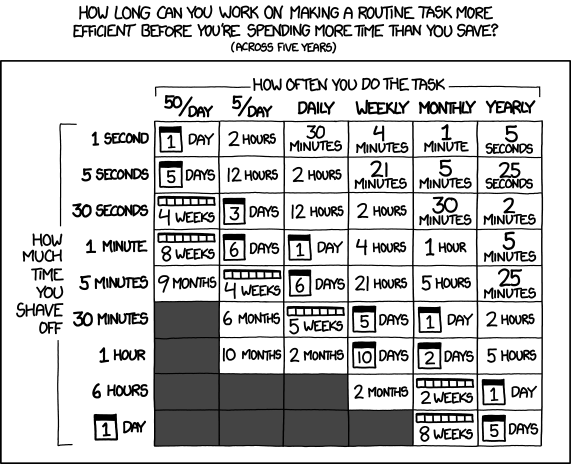
Largely. If we can spend a few extra minutes finding a better way to do something more efficiently, such that we save more in the long run than we invested in the improvement, we should. For example, making an extra phone call and finding a place that will print ads for 10 cents per page, rather than 12. Or taking time to learn a faster way of designing the ad layout. XKCD conveniently mapped that cost/benefit analysis for us:


However, it's impossible to run the entire ad campaign efficiently (regardless of research suggesting that the efficacy of online ad campaigns is still frequently a mystery). Because the entire campaign is driven by actions taken long before it starts, before we start poring over data from A/B testing. Can we run it effectively? Yes. But the knowledge of the people running it, the relationships between them, the mentor that encouraged the copywriter to stay in their job? We can't capture that complex system well enough to navigate it efficiently.

A colleague can efficiently, at 60 wpm, type us an email warning us of a major problem coming down the pike. But it might not be efficient in the context of their mandate, and we certainly didn't worry about efficiency building the relationship with that person. Coffee meetings aren't, at the individual level, very efficient.

But at the organizational level, coffee might be the killer app. Even 12-person lunch tables are more effective for software developers than 4-person ones, in that they lead to less compatibility issues in the code.

Even the potential of the digital era to feed us the information we're looking for algorithmically is increasingly driven by human relationships: what the people we interact with are reading, who are we following, and who can we trust to act as amplifiers and filters.

ConocoPhillips reports that they've saved $100 million by encouraging employees to help each other solve problems. At the macro level, it's clearly "efficient". At the individual level, hardly.

We can't take an efficient approach to knowledge work. It's too complex. Instead, we have to trust ourselves and rationally apply macro-level knowledge, such as that collaboration works for organizations. Even when it's hard to see how it serves the pressing needs of the individuals within the system.

The factory-driven logic of efficiency may still apply to tasks and processes, but even there the logic is messier than you'd think. What if a theoretically less efficient system gets more use because it better matches the culture of a community? Or because it has buy-in, having been developed locally?

Digital interactions with government are an easy efficiency win. Filling out health care paperwork online is a far cheaper, quicker transaction for both parties, but what if the visit to the office creates the opportunity to discuss an emerging health concern? Expensive in-person contact with health care professionals is often worth it, in keeping people from needing even more expensive hospital stays later. In a few years we may be working on how to strategically get people through government doors at key intervals to bolster a digital by default strategy.

Knowledge work is a relational game, and we need to tread the language of efficiency cautiously. When combined with inevitable oversimplification and incentives designed for parts, not wholes, efficiency just isn't effective.