Wednesday, February 12, 2014

Millenials, Lego, and the Perimeter of Ignorance

by Kent Aitken RSS / cpsrenewalFacebook / cpsrenewalLinkedIn / Kent Aitkentwitter / kentdaitkengovloop / KentAitken

Every time I read an article about Gen Y or Millenials I run it through this litmus test: throughout the text, can you replace "Millenial" with "employee" with no loss of meaning?
 “[Employees] want meaningful work, they want to do things that are making an impact and if they’re not in a good environment where they can do that, they’re always going to be looking for something else"
From this piece, which was - sadly - actually about Millenials.

Of course, there are legitimate and meaningful trends and changes occurring, even about Millenials (I'd give more credence to this idea about changing prioritization between work and family life). But it's worth it to be skeptical, to put ideas in broader context, and to look for what's truly meaningful.

Baby boomers are retiring, or about to. Deloitte has suggested that this wave of retirements has been delayed slightly - by "better than expected health" and "worse than expected wealth" for would-be retirees - but here's the demographic profile of the public service up to 2012, Boomers identified by forward slashes:
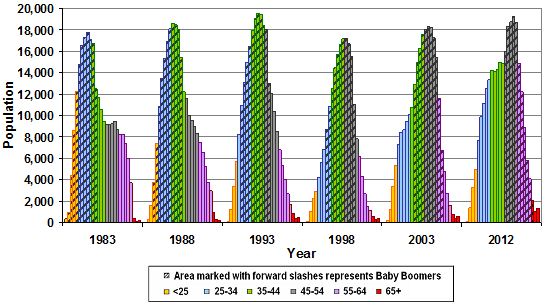
Figure 7

Over the next decade, we're going to see a demographic shift in key positions throughout the public service. But the question is: does that matter?

And why?


The Perimeter of Ignorance

Here's my frontrunner idea for why it might. I don't think living in the age of information leads directly to collaboration as a first-order condition. Instead, I see collaboration as a second-order condition of a more fundamental result: being constantly reminded of one's ignorance. Collaboration is a symptom, in this view.

Admittedly, this isn't really new. It's not like there was a period of human history in which our knowledge was static. The idea of heliocentrism, for example, would have been world-shattering, dramatically changing the parameters within which people constructed their beliefs. But it seems as though people throughout much of history always considered that the universe ended where their knowledge did, simply expanding the universe slightly when their knowledge grew.


"It's Like Lego."

I simply think that the recognition - deep-seated, not just logically, on principle - that we don't know everything has taken hold, and reached much further into the bulk of populations. The plural of anecdote is not evidence, but this has been on my mind lately:
  • In the last few weeks I've met two people whose lives' work was connecting people, based on the idea that all the building blocks for building a better society are already there, the question is simply one of assembly. "It's like lego."
  • Lately I've had the opportunity to help colleagues with marketing campaigns, internal strategies, and policy presentations, somewhat awed by the idea that I had something to contribute to any of these.
  • Last week Tariq posted about Planning and Idea Generation in Government, in response to Chelsea's point that even deciding that something is a good idea is a muddy and difficult process.
  • Which led to a conversation about decision-making models. Some very (very) smart people were debating their merits. One view would be that they're a useful heuristic, and I'd add that their existence and popularity is based on a recognition that we'll muck things up simply by throwing neurons at problems. But at the same time they have limits, and over-reliance can lead to sub-optimal results.
Or, this, from Joeri van den Steenhoven from the MaRS Solutions Lab:
"We never have all the knowledge in place. So we have to learn... Mostly, it's about organizing a learning process for the stakeholders and users involved, and trying to find out together how we can bring about successful change."

Strategy in a Gigantic Universe

I didn't intend this when I started writing, but this gets back to the last few weeks of posts: Nick on Blending Public Sentiment, Data Analytics, Design Thinking, and Behavioural Economics, or me on Building Distributed Capacity. These posts could be read as buzzword-heavy, or as reasonable management strategies in a world where solutions are elusive, subjective, and fleeting. As ways to, as Josh McManus suggests:


What do you think? Is increased recognition of our limits a genuine shift? Or am I unfairly assigning importance, or missing longer-term context? Is a more collaborative, tentative approach to solution-generation actually a characteristic of those people who'll be replacing retiring Boomers?

And what would that mean for the public service?

I think it's important to look at possibilities and plausibilities for the public service in the long term. To be perfectly honest, my interest in determining whether or not this idea means anything is partially driven by the conversations that came out of George's leave and Nick's interchange from the public service. It seems staying or exploring opportunities elsewhere is on many people's minds.

That's quite alright. We can go "from Public Service to public service," as George put it. But I'm interested in at least complicating these decisions by pointing to opportunities for positive change in the public service. It seems to be the problem I've fallen in love with.

Wednesday, February 5, 2014

Tune in, Turn on, Drop out - Planning and Idea Generation in Government

by Tariq Piracha RSS / cpsrenewalFacebook / cpsrenewaltwitter / tariqpiracha

In response to my last post, a friend commented about the risk involved in trying to generate the best merit-based ideas: “best ideas according to whom and why? What is best?”

Clear and measurable objectives are crucial to success when tasked with idea generation in government. I think her question is well worth consideration. But if we’re looking for an objective or static measurement for what constitutes the “best idea”, I think we’ll be disappointed with the results.

It is the essential nature of democracy: the ideas that are generated, tweaked and implemented are a matter of choice. We look at the data, the issues, the context, and we make the best recommendations we can. It may not be the most effective or efficient course of action, but once we incorporate the multitude of interests, risks, and limitations, someone must ultimately make an informed choice.

That said, the best choice, that is made within a particular context at a particular point in time, may no longer be the best choice as the environment changes. The question that interests me is not so much “what is best”, or even “what are we going to choose”, but instead “how are we going to adapt?”

To do that, I think we need to address at least three elements: With a nod to our 60’s counterculture, I’d suggest it’s important to know how to tune in, turn on, and drop out.

Tune in: We need to pay close attention to our environment. If our environment is changing, we should know about it now; not in a year when it is time to wrap up a project and evaluate performance.

Turn on: We need to know how to turn on a dime. If we’ve got our finger on the pulse, we are better positioned to pivot and adjust course if necessary.

Drop out: Sometimes, well, we just may need to abandon an approach and start from scratch, or move on.

If we have established clear, measurable goals, and we are evaluating our progress every step along the way (and not just at milestones), we may discover that our ideas need to change. The environment, the data, may show us that it needs to.

I've written in past about the need for agile government and the dangers of focusing on projects instead of iterative process. It’s that iterative approach that can help us be more agile.

Cass Sunstein in Simpler talks about the need to assess and adjust policy after it has been implemented. We can no longer afford to “set it and forget it” when it comes to policy and law as no policy or law will be perfect out of the gate.

This position was also recently expressed by Dana O’Donovan and Noah Rimland Flower from the Monitor Institute with regards to how we assess and implement strategic plans.

The 5-year plan, or even annual strategic plans, are no longer providing the flexibility and effectiveness in a world that is changing so rapidly, where citizens are needing responsive and responsible government support.

“Best” may be a misleading word - it is certainly not some objective measurement when it comes to how the government works. It is contextual relative to the various pressures that any developing policy may face.

However, if we can set clear, measurable objectives, scan the environment frequently, measure our progress early and often, and adjust appropriately to changes in the environment, then I think we'll be well on our way to seeing useful progress. And useful ideas.

Tuesday, February 4, 2014

Hackable Government

by David Fleming RSS / cpsrenewaltwitter / northeenddavid

David is an economist, business association leader, cyclist and urbanist in Halifax, Nova Scotia. He blogs infrequently at http://dfleming.ca and tweets @northenddavid.


A little while ago, I wrote an article for Halifax's alt weekly The Coast about demographic trends in Nova Scotia and the need for a bold youth agenda in Nova Scotia. The article caught fire - after thousands of shares, tweets, and emails, it was clear it struck a nerve among my peers.

In the article, I listed a number of common themes I hear from young professionals that would make Halifax a place to flock to. Kent picked up on one - hackable and transparent governments - and asked me to elaborate on what I think its relationship to attracting people is, and to public service renewal.

There are a lot of signs, both above and below our border that people are disengaging from their political processes. The chasm between government and citizens has arguably never been bigger. In the past 50 years, we’ve gone from local government directories with people’s names on them to national or regional offices with 1-800 numbers. Government offices were once a place you could go to ask a question - now, many of them are fortresses of security, often located in inaccessible places like business parks. When you ask many public servants what they do, it’s a sea of inside baseball terms and acronyms - with no clear answer on what relevance that has to the asker.

I believe at our core most of us are hackers. Whether we’re programming sentry guns to spray squirrels in our backyards , building DIY greenhouses, or simply collecting other people’s good ideas - most of us aren’t content with staying at our current level of interactivity with the world around us. I believe, if we’re truly looking at public service renewal and ways to engage our citizens in the places they live, we need to give people the chance to be a part of the hacking of the public service.

On a tangible level, something as simple as freely releasing GPS data for busses has a momentous effect on the public interaction with service. Instead of waiting for busses on the hope that the planned schedule matches reality (which generally leads to a lot of frustration and distrust) - people can build tools so that people can avoid missing an early bus or standing out in the rain for one that’s late. They can build tools that provide specialized help to 1, 10, or 100 people with a common problem (such as the desire to intersect public transit and art venues to plan an event.) The only limit is the public’s desire to create an outcome. And, even better - with a more complete set of data, they can test, analyze and suggest ways to realistically improve the efficiency of that service from the perspective of a user.

The benefit of creating hackable governments is two-fold - one, people feel more agency and control over their public services - and two, governments get better information from its citizens about what they need. On both sides of the spectrum, it creates public engagement and liveability. Those are pretty great areas to focus on when looking at public service renewal - how can we use the amazing tools and power of the collective to get people back into solving public problems and creating good outcomes for each other? Instead of looking at public service renewal as an inner working of the government - how do we get it out into the public for design input?

In a future article (either here or on my personal blog), I’ll continue the conversation about how simple changes to things like information design and performance metrics can create huge changes in this area.